HANDMADE CUSTOM-FIT HOLSTERS FOR ALMOST ANY GUN



.jpg&width=88&height=88&webp=1&type=cover)

.jpg&width=88&height=88&webp=1&type=cover)


.png&width=88&height=88&webp=1&type=cover)

.jpg&width=88&height=88&webp=1&type=cover)


.jpg&width=88&height=88&webp=1&type=cover)


Why Carry Feels Different When Sitting and How to Fix It
Most of us don’t spend our entire days standing or sitting. If you’ve been carrying for awhile, you’ll know that this simple fact of life presents some unique challenges when it comes to not just concealment, but comfort, and equally as important, access to the firearm. For me, what I notice most is that the grip starts digging into my side (for strong side carry), the muzzle pokes my thigh or pelvis, and what felt invisible a minute ago suddenly feels like I'm smuggling a brick under my shirt, regardless of what gun I’m actually carrying. If you've carried for any length of time, you already know exactly what I'm talking about. This isn't your imagination, and it isn't a sign you bought the wrong gun or even necessarily the wrong holster. It's simply just geometry. Your body naturally changes shape when you sit, and your holster has to work a lot harder to keep up with it since it's an inflexible object. Today I want to break down why sitting throws off a setup that felt great standing, and more importantly, what you can actually do about it to make it a bit less awkward.

Your Body Bends, But Your Holster Doesn't (Always)
When you stand, your torso is basically a straight line from your ribs to your hips. Your waistband sits where it's supposed to, your belt holds tension evenly, and the holster rides at a consistent angle against a relatively flat plane.

The moment you sit down, that straight line folds. Your hips rotate forward, your stomach compresses, and the distance between your ribs and your belt line shrinks considerably depending on your build and the chair you're in. A holster that was riding comfortably along your side now gets pinched between a shorter torso and a beltline that hasn't moved. The grip that cleared your ribs while standing now jams right into them. Worse, in a car seat, the seatbelt and the angle of the seatback add even more pressure on top of all that compression.
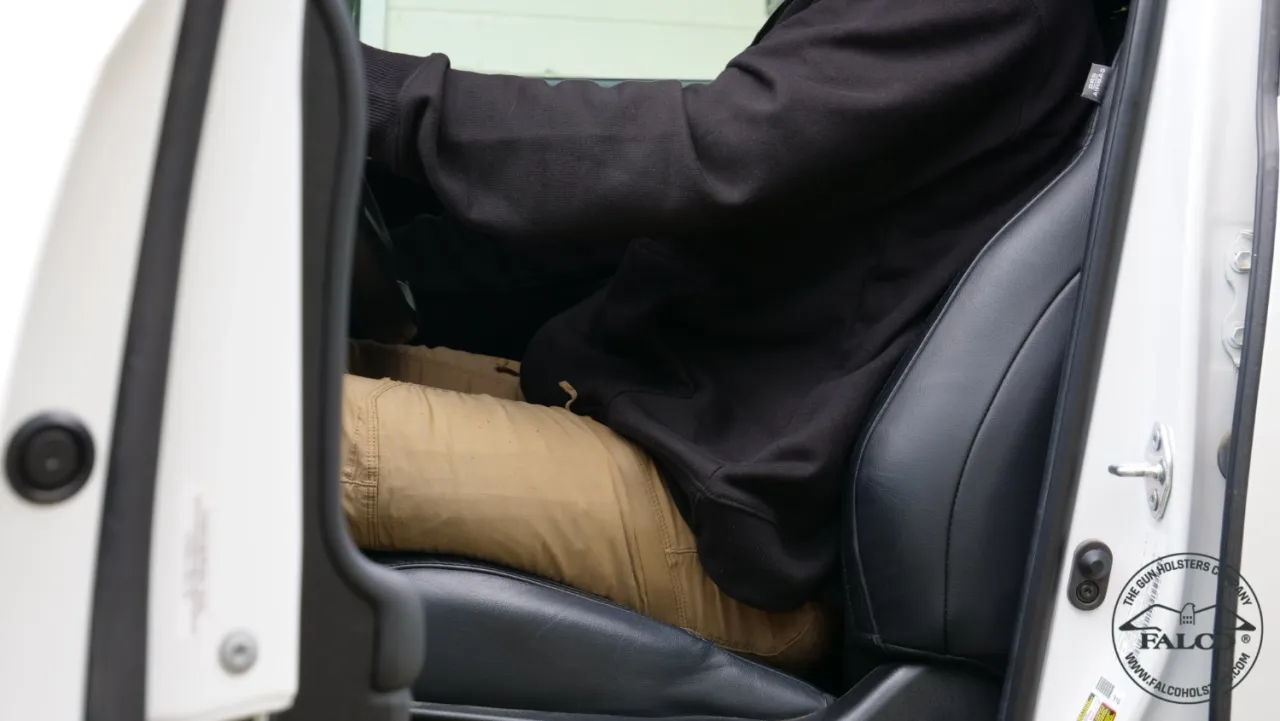
This is especially true for those who prefer to carry appendix, like myself. AIWB is fantastic for both accessibility and concealment while standing, but sitting folds your body directly over the gun, jamming it right towards a very sensitive area of your body. That's the tradeoff nobody mentions when they're hyping up appendix carry as the "best" position. It's not the best for everyone in every posture; it's the best for certain bodies and certain situations, including sitting if your goal is to maintain easy access to the firearm or avoid getting jammed up against a seatbelt. This is not possible for every body type, mind you, which is part of the reason that you should start with a holster that has some level of adjustability built into it.
For you old-school thinkers, strong-side IWB and OWB carriers aren't immune either. Sitting rotates your hips and shortens your torso just the same; it just shows up differently. Instead of muzzle pressure in your gut, you might feel the back of the grip digging into the small of your back or jabbing into the car seat or chair behind you.
Why a Great Standing Setup Can Become a Bad Sitting Setup
A lot of carriers chase the perfect standing concealment and never test the seated position before committing to a holster. Most of us probably try on gear standing in front of a mirror because that's how we shop. But you don't live your life standing in front of a mirror. You drive, you sit at desks, you eat dinner, you sit through long meetings, hell, some of us climb over things and run around for a living. If your holster only works in one posture, it's only half doing its job.
The biggest culprits I see again and again usually come down to a handful of setup issues. Can't angle relative to your belt line is probably what I see the biggest disagreement on, especially when it ignores seated geometry entirely. However, probably more important is belt tension. A loose belt lets the holster shift and rotate as your body moves, so the gun ends up wherever gravity and your hips decide to put it instead of staying where you actually intended it to be. However, at the same time, overtightening the belt can lead to extreme discomfort, and also could possibly dislodge your firearm in some unique circumstances with specific holsters.
Finally, and not least important, is the style of retention as well as the backing material that your holster is using. Chief among the worst culprits are materials that simply don’t flex with you. A rigid backer that doesn't move with your body has to fight your body for space, and your body usually wins that argument, which just means more discomfort for you in the long run, which is why I am a huge fan of Falco’s Hybrid holster designs, which are both more comfortable and better flex and conform to your body over time as you wear them in, without sacrificing on the retention side of things.
How to Actually Fix It
The good news is that none of this requires giving up on your favorite carry position. It just means testing and adjusting with intention and being honest about yourself and the goals of your carry setup. As I said earlier, I value quick access to the firearm, and ultimate flexibility over strict comfort for my daily carry. As a result, I’m currently carrying AIWB with one of FALCO’s A911 TalonGuard Hybrid Holsters. While this isn’t anything special, the fact that I’m using it in tandem with the extremely tiny Smith & Wesson Bodyguard 2.0 means this setup has minimal impact no matter what position I’m carrying in, which is part of my methodology. However, here are some suggestions if you’re having trouble with your current setup.
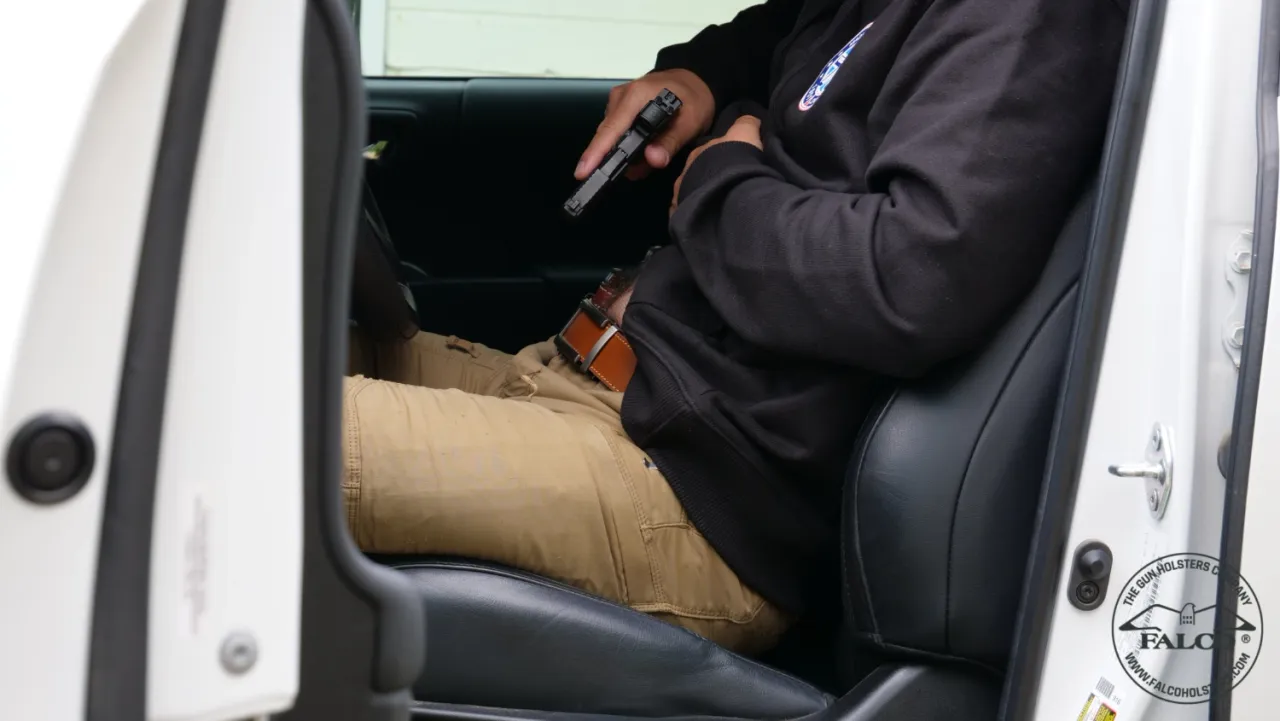
Sit!
If you’ve just bought a new holster and are unsure if it's a good all-around fit, first, and probably most obvious, is to try and sit down before you commit. Holster companies, including FALCO, often offer customer-friendly policies (for example, FALCO may provide store credit toward a different holster, allowing customers to choose a better-fitting option without returning the original one). So whenever I'm evaluating a new holster, the first thing I do after trying it standing is sit in my actual truck seat, not just a kitchen chair. Office chairs, bucket seats, and bench seats all compress your torso differently. If a setup feels good in all of them, you've found a winner. If not, don’t be afraid to ask for a return; good companies will be happy to accommodate because they want you to have the best holster fit for you. Ultimately you’re going to have to conform to the limitations of your dress-code and your environment, so don’t feel bad if you have to change something.
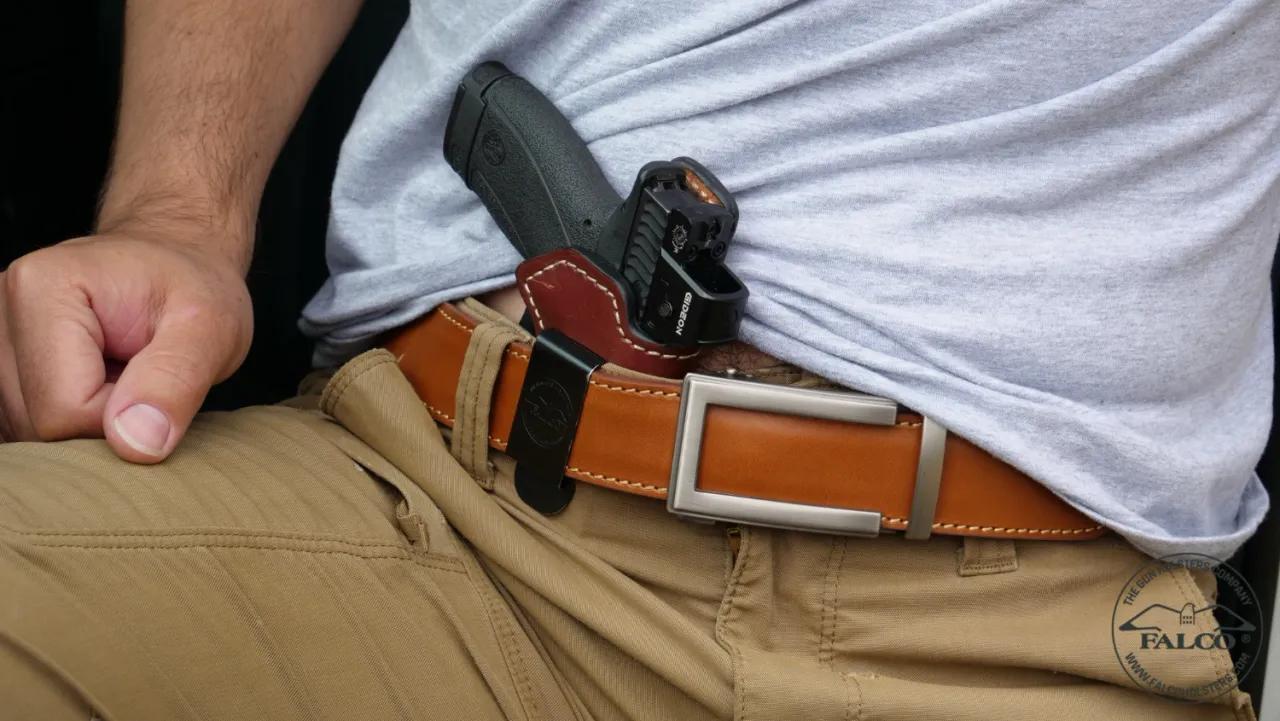
Cant!
Next, you should adjust your cant. Small changes here make a massive difference. A slight forward cant for appendix carriers often clears the thigh better when seated. For strong side carriers, a slight rearward cant can keep the grip from digging into your back when you lean into a seat. FALCO's hybrid and Kydex holsters are built with this kind of fine-tuned cant in mind, and a lot of our designs allow for adjustability so you're not stuck with a single angle that only works in one posture.
Ride Height
Raising or lowering the holster on your belt by even half an inch can take pressure off your ribs or hip when seated. This is one of the easiest and cheapest adjustments most carriers never bother to make. I cannot stress this enough. A stiff, properly sized gun belt keeps the holster anchored in place instead of letting it shift and rotate every time you move. If you're still using a regular dress belt or a worn-out one from years ago, that's very likely contributing to your sitting discomfort more than the holster itself is.
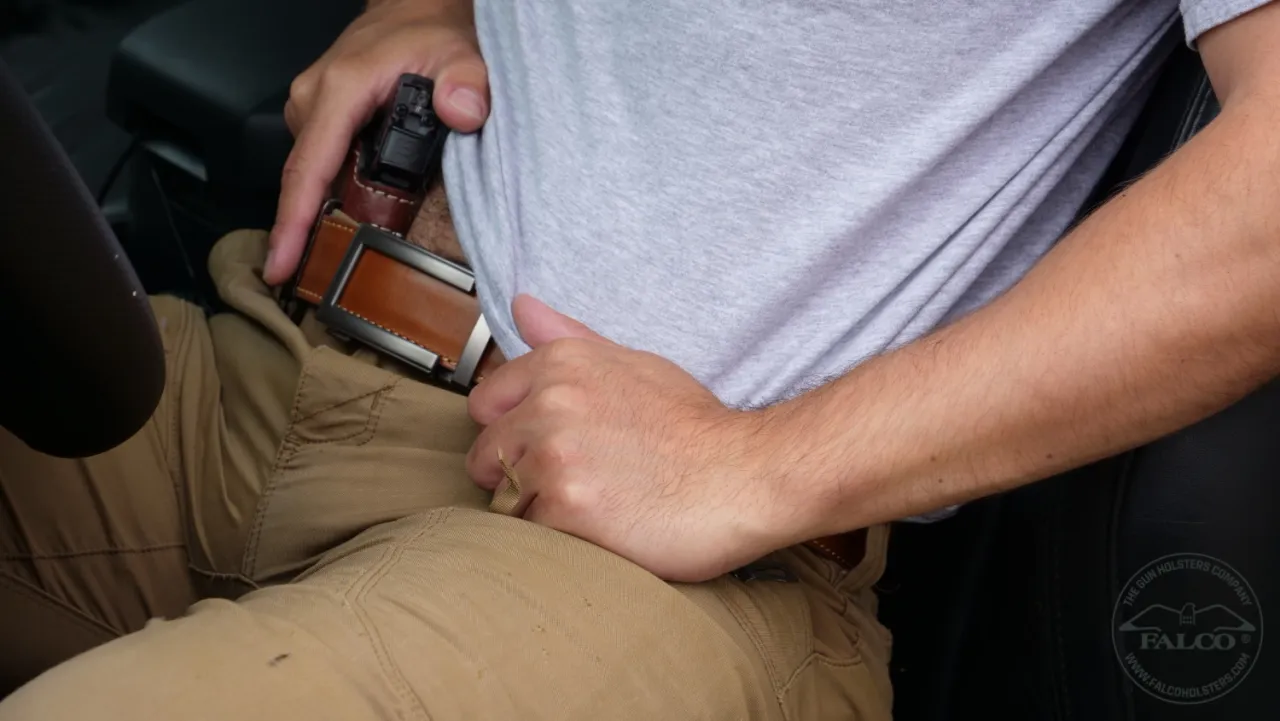
New Positions
Try a different carry position altogether. If you sit for a living, behind a desk, in a delivery vehicle, in a rideshare, appendix or strong side IWB might just not be the right tool for your day. Holsters built for the small of the back or even a quality OWB under an open layer can solve sitting discomfort entirely for some body types, while pocket carry or a quality ankle rig can be worth a look for short trips where you're seated more than you're standing.
Get the BEST Holster
And finally, if I haven’t said it enough already, try a hybrid holster with a leather or soft backer that flexes with your body in ways pure Kydex can't. That flex is exactly what you need when your torso is folding and compressing in a car seat or office chair all day, and the bonus here is that the leather is far more comfortable than a Kydex shell against your body for an extended period of time.
Don't Just Live With It
I used to assume sitting discomfort was just the cost of doing business as an everyday carrier. I started carrying in the days when super affordable kydex and hybrid holsters weren’t quite a thing yet. Instead I'd shift in my seat, wear larger concealment garments, and tell myself that's just how it is. It wasn't until I started actually testing holsters through a full day, standing, sitting, driving, sitting again, that I realized how much of that discomfort was fixable. Most of it came down to just two adjustments that took me all of five minutes once I knew what to look for.
If carrying makes sense standing but turns into a wrestling match every time you sit down, don't write off concealed carry as just uncomfortable by nature. I think that’s actually one of the things that keeps most people from committing to the daily practice of concealing a firearm for their own defense and the defense of their community. As someone carrying a firearm in public, it’s on you to test your setup the way you actually live: behind a wheel, at a desk, in a booth at your favorite diner, and then make the small adjustments that get it right in every posture.


Luke Cuenco
30.6.2026


