HANDMADE CUSTOM-FIT HOLSTERS FOR ALMOST ANY GUN



.jpg&width=88&height=88&webp=1&type=cover)

.jpg&width=88&height=88&webp=1&type=cover)


.png&width=88&height=88&webp=1&type=cover)

.jpg&width=88&height=88&webp=1&type=cover)


.jpg&width=88&height=88&webp=1&type=cover)


Horizontal vs Vertical Shoulder Holsters and Which One Fits Your Gun
A horizontal shoulder holster carries the gun flat under your support-side arm, with the muzzle pointing behind you. A vertical shoulder holster hangs the gun muzzle down, with the grip up. The horizontal rig is faster to draw from, but a long barrel prints through the back of your jacket. The vertical rig might be slower, but it carries large, heavy handguns, and a long barrel points down instead of printing at your back. That's why the length of your gun usually decides which one to buy: shorter guns go horizontal, and longer guns go vertical.
We're FALCO Holsters, a company crafting custom-fit handmade holsters for almost any handgun and light, and we build both kinds of shoulder rig. People look to us for shoulder carry when they need a way to carry that isn't on the waistband, particularly drivers, hikers, hunters and people who can't dress around a belt holster.
What is the difference between a horizontal and a vertical shoulder holster?
The difference between a horizontal and a vertical shoulder holster is the angle the gun rides at. Both hang under your support-side arm from a shoulder harness, and the angle changes how fast you can draw, which guns fit, how long a jacket you need and where the muzzle points.
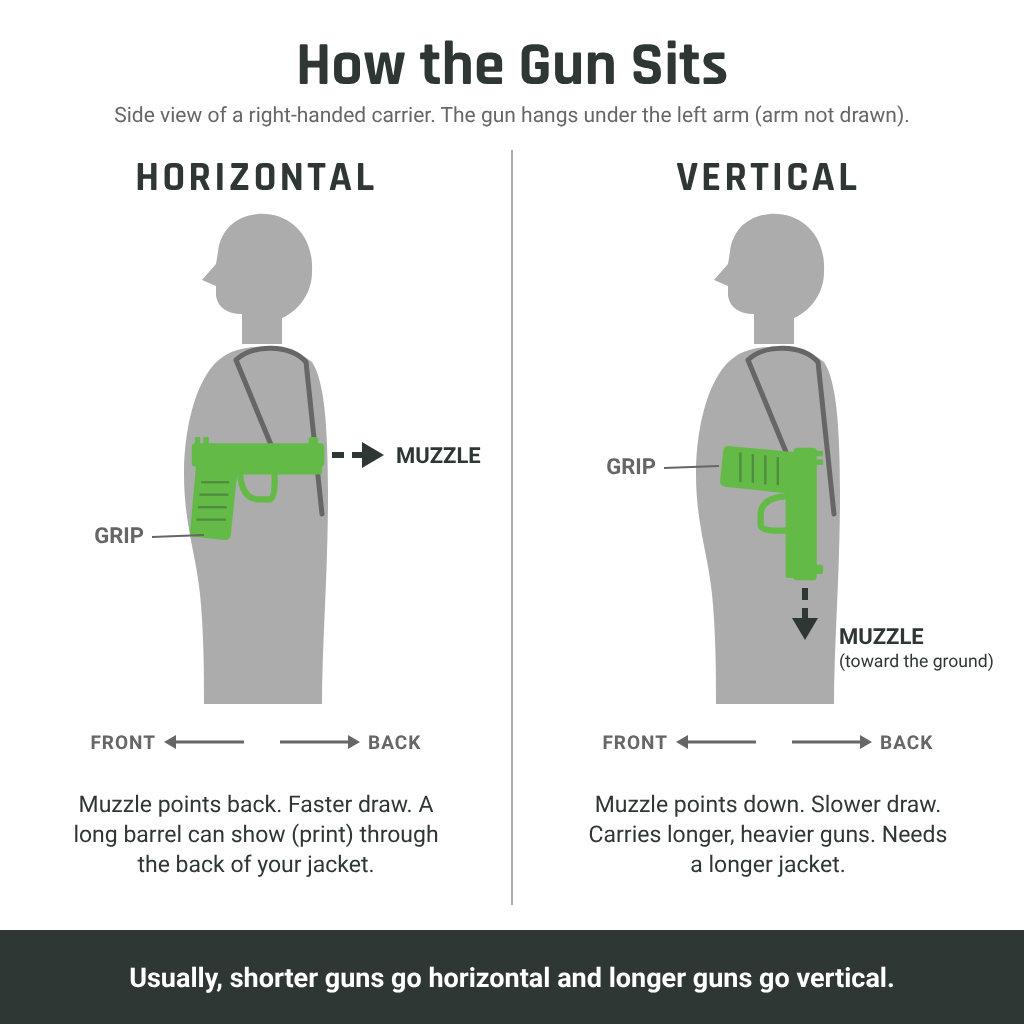
| Horizontal | Vertical | |
|---|---|---|
| How the gun sits | Flat, grip forward, muzzle pointing back | Muzzle down, grip up |
| Draw speed | Faster | Slower |
| Best gun length | Compact and shorter guns | Full-size pistols and long barrels |
| Jacket length | A shorter jacket can cover it | Needs a longer jacket |
| Muzzle while you wear it | Points behind you | Points at the ground |
| Usual retention strap | Thumb break | Varies: a security strap or a thumb break |
Which shoulder holster draws faster?
A horizontal shoulder holster draws faster because it carries the grip forward. Grant Cunningham, a revolversmith and shooting instructor, writes in Gun Digest that horizontal holsters "are certainly the easiest to draw from" and that the butt is carried "the furthest forward of any style." Dylan Saunders of Duty and Defense adds that "a horizontal orientation allows a more natural draw," because it matches the natural position of your wrist. Drawing up out of a vertical rig means turning your wrist, and Paul Rackley of American Rifleman calls the muzzle-down rig "probably the slowest on the draw."
The thumb break on a horizontal rig takes back some of that speed. Most horizontal rigs use one, including 36 of our 40 horizontal models. Massad Ayoob, writing in The Armory Life, says he can't argue with the old claim that horizontal carry is the fastest, but that the thumb break "can eat up that time saving." Draw speed still favors horizontal, by a smaller margin once the thumb break is counted.
Either orientation asks you to reach across your chest to the grip. Cunningham's experience is that most men don't have the upper-body flexibility to draw that way efficiently or safely, and most women do. Try the reach before you buy either kind.
Which shoulder holster conceals better?
Neither orientation conceals better for everyone. Which one hides your gun depends on how long the gun is, how deep your chest is and how long your jacket is.
A horizontal rig lays the length of the gun across the depth of your torso, front to back. Cunningham notes that on a horizontal rig "the muzzle tends to poke out at the rear and the butt in the front." There's no fixed barrel length where that starts, because it depends on how deep your chest is as much as on the gun. Rackley's rule is that unless the carrier is very large, only shorter-barreled guns ride horizontally without the muzzle printing through the back of the cover garment.
A vertical rig points the barrel down instead of toward your back, which helps with bigger guns. Saunders found that "a vertical orientation allows better concealment, especially with larger pistols." The drawback of a vertical rig is jacket length. Gun Tests found in its shoulder holster comparison that "while a shorter covering garment may conceal a horizontal holster, this isn't the case with the vertical type."
Which shoulder holster fits my gun?
| Your gun | Start with | Why |
|---|---|---|
| Subcompact or compact pistol | Horizontal | The short slide stays under a jacket, and you keep the faster draw. |
| Full-size pistol or 1911 | Vertical, unless the slide stays hidden in a horizontal rig on you | The longer slide prints out the back of a horizontal rig on many carriers. |
| Pistol with a weapon light | Judge by the length of the gun and light together | A light that reaches past the muzzle makes the gun longer, and a longer gun is more likely to print in a horizontal rig. |
| Short-barreled revolver | Horizontal, or vertical if you want the muzzle down | A short barrel rides horizontally without printing. |
| Long-barreled or full-size revolver | Vertical | A long barrel prints in a horizontal rig. |
| Scoped hunting revolver | A chest holster, such as our D112 Lumberjack | A scoped revolver needs a rig built around the scope. |
For full-size pistols, vertical is the usual recommendation. Rackley says the vertical rig "allows for a larger gun to be carried, such as a Government Model 1911 or a full-size revolver," and Gun Tests says the vertical holster "allows the carry of relatively large and heavy handguns." Horizontal can still work with a full-size gun. Gun Tests' comparison included a Government Model 1911 in a horizontal rig, and across all the holsters in that test, 75% of its raters preferred the horizontal type.
Our own rule of thumb is that if your gun is longer than your chest is deep, it belongs in a vertical rig. A very long gun, such as an S&W X-Frame revolver, would stick out far behind you in a horizontal rig, and you couldn't conceal it. A full-size 1911 can ride horizontally on a carrier with more mass on the chest, whether that's muscle or fat.
We've also noticed that huskier carriers can find it harder to draw from a vertical rig, so many of them choose a horizontal one.
Whichever orientation you choose for a gun with a light, the holster has to fit the light as well as the gun. We make light-bearing shoulder holsters in both horizontal and vertical versions, made for the gun and light together, and we fit more than 180 weapon lights.
Where does the muzzle point in each type?
| Orientation | While you wear it | During the draw |
|---|---|---|
| Horizontal | Points toward the rear | Swings across the front of your body and passes close to your support arm |
| Vertical | Points at the ground | Clears the holster below your support arm when you raise that arm out to the side |
Cunningham calls the horizontal rig "the only shoulder holster where it is impossible to draw without sweeping the muzzle across an unintended target." Ayoob points out that on a horizontal rig the muzzle passes close to your own support arm.
On a vertical rig, Ayoob says, you can bring your support arm up and out to the side "because the muzzle will clear the holster well below that level." A vertical rig can still sweep the muzzle if you draw it the wrong way. Ayoob warns against pulling the gun down and out of the holster, as seen "in so many books and advertisements." That downward movement swings the muzzle toward the rear and toward your holster side, the side your rig hangs on, and it leaves the gun too low to aim. His fix is to pull straight across the chest.
With either orientation, Mike Boyle notes in The Armory Life that untrained shooters tend to swing the pistol in a wide arc as they draw, which carries the muzzle across their own support arm. Learn the draw for your orientation from a qualified instructor, and practice it with an unloaded gun before you carry.
Which is better for driving, a desk job or a long day outdoors?
- Driving and desk work. Gun writers recommend shoulder carry for people who sit behind a desk or a steering wheel, but they don't favor either orientation for it. Pick by your gun and your jacket length.
- A long day outdoors. For a long day, look at two accessories, whichever orientation you choose. A counterbalance is a magazine pouch under your other arm that offsets the weight of the gun, so the harness sits evenly. A tie-down strap secures the holster and the counterbalance to your belt.
What other shoulder holster types are there?
Beyond plain horizontal and vertical rigs, you'll run into a few other shoulder holster types:
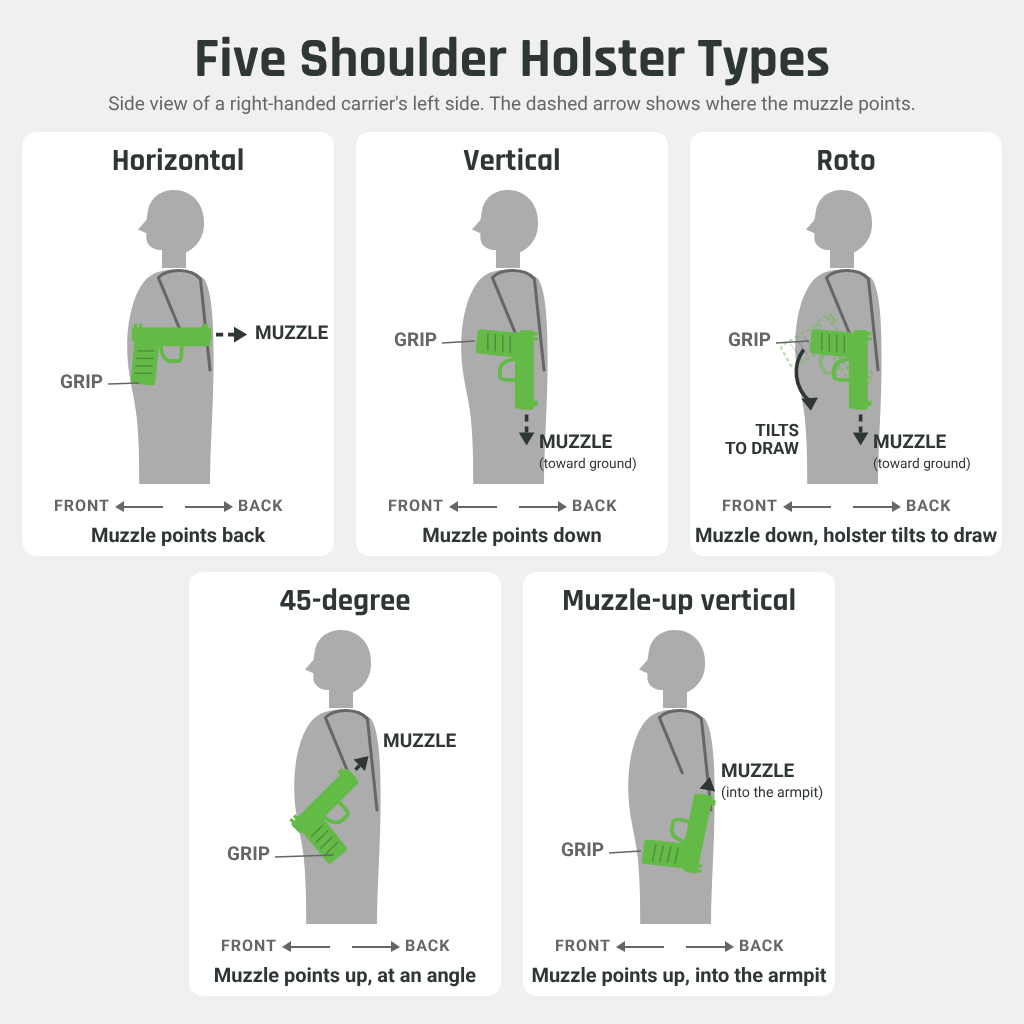
- Roto holsters. A roto holster carries the gun vertically, muzzle down. Ours hold the gun with a forefinger strap, a safety strap you release with your forefinger, and once it's unsnapped the roto design allows an angled draw. That gives you vertical carry with a draw closer to a horizontal one.
- 45-degree holsters. These carry the gun at an angle with the muzzle pointing up. Cunningham calls them "a workable compromise" and notes they work "with slightly longer barrels than the horizontal types."
- Muzzle-up vertical holsters. Often called upside-down holsters, these hold the gun straight up and down with the muzzle pointing up. Cunningham finds the grip harder to reach on these than on a 45-degree rig.
Which Falco shoulder holster should you look at?
We make 40 horizontal and 36 vertical shoulder holsters, with our roto rigs counted among the vertical ones. Our custom-fit holsters are molded to the specific gun they're made for, and we fit more than 3,600 handgun models, about 900 of them revolvers.
For each orientation, we've picked from our best sellers, plus one versatile option for anyone who can't decide. All eight come in right- and left-handed versions.
Horizontal
- DM01 Leather Universal Shoulder Holster With Double Mag Pouch: our best-selling horizontal holster. The holster fits pistols and revolvers. It has a steel-reinforced thumb break and an open muzzle that leaves room for compensators and extended threaded barrels. It hangs from an adjustable shoulder harness with belt straps, and a vertical double magazine pouch under your other arm acts as the counterbalance. You can order it custom-fit to your gun or as a Multifit version, made to fit a range of similar guns rather than molded to one model.
- D905 Horizontal Kydex Shoulder Holster with Double Mag Pouch: a Kydex holster made for your specific handgun. Kydex holds the gun on its own, so there's no thumb break to release. That makes the draw easier and more efficient. It comes with an adjustable cross-shoulder leather harness, a Kydex double magazine pouch and leather tie-down straps. It fits handguns up to compact pistols and mid-sized revolvers, the shorter guns a horizontal rig suits best.
- D635 Dayton: a horizontal holster for pistols and revolvers from our Timeless line. Timeless holsters are made from 1/8 inch full-grain Italian leather, with concealed hardware and a reinforced mouth. The D635 has a steel-reinforced thumb break and a cross-shoulder harness that goes over both shoulders, with belt straps and a counterbalance that holds two magazines.
Vertical
- D122 Vertical Leather Shoulder Holster with Adjustable Harness: a vertical holster made for your specific handgun, with a forefinger strap, a single leather shoulder harness that goes over one shoulder, and leather tie-down straps. It fits handguns up to full-size pistols and large frame revolvers. It comes in two versions. Premium (D122) uses leather we dye and lacquer in our workshop. Classic (D222) uses leather that arrives already colored from an Italian tannery, which leaves it slightly softer and less glossy.
- DM04 Leather Universal Vertical Shoulder Holster: a vertical holster with a steel-reinforced forefinger strap, an adjustable cross-shoulder harness and a vertical double magazine pouch as the counterbalance.
Roto
- D120 Leather Roto-Shoulder Holster with a Harness and Double Magazine Pouch: a roto holster made for your specific handgun. The gun rides vertically. When you draw, the holster's folding function lets you tilt the gun slightly forward, which makes the draw more comfortable. It has a forefinger strap, a cross-shoulder harness, a double magazine pouch, leather tie-down straps and an open bottom for threaded barrels. It fits handguns up to full-size pistols and comes in Premium (D120) and Classic (D220) versions.
- D633 Johnson: a Timeless roto holster with a steel-reinforced forefinger strap and a counterbalance pouch for two magazines.
If you can't decide
- D702 Lucas: one nylon holster you can set up as a horizontal or a vertical shoulder holster, or wear on the belt at two cant angles. It comes with a nylon cross-shoulder harness and an adjustable, removable thumb break. It's made to fit a size category of guns, such as compact or full-size, rather than molded to one model, so it's a sensible way to try both orientations before you commit to a leather rig molded to your gun.
Besides leather and Kydex, our shoulder holsters also come in hybrid and nylon. If you already have a rig and need a new harness or straps, you'll find them on our shoulder harnesses page. When your holster arrives, our guide on how to wear a shoulder holster walks you through fitting the harness.
When you know which orientation you want, browse our horizontal shoulder holsters or vertical shoulder holsters, pick your handgun and light, and we'll make the holster to fit them. Custom-fit holsters are made to order and typically ship in about two weeks. If you're still torn between the two, email us at [email protected] or use the chat on falcoholsters.com, tell us what you carry, and we'll help you choose.

Martin Lukačko
15.10.2026


